
Authentic Idiocy vs. Artificial Intelligence: Why the Clown May Be the Guardian of Our Humanity
Feb 05, 2026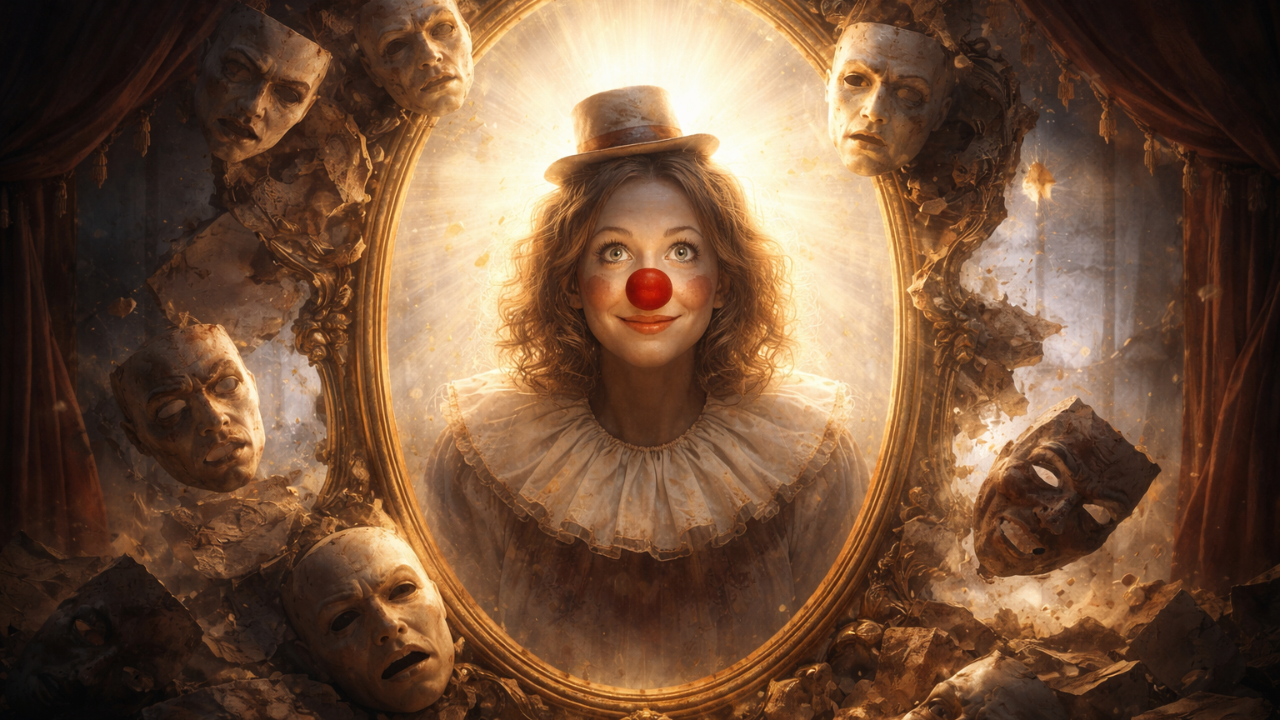
We are living in a time when intelligence is being defined, measured, simulated, and increasingly outsourced.
Artificial intelligence writes our emails; algorithms predict our desires.
Optimization is replacing intuition, and hollow performance replaces true presence.
Perhaps this hollowness has always been a synthetic undercurrent in our life, and now it has become garish, undeniable, and overbearing.
Any feeling being senses now, that beneath all of this sophistication, something simple and essential is being lost.
Our humanity.
In a recent conversation on The Grace Space, artist, clown, and consciousness explorer Annie Newton offered an unexpected counterpoint to our cultural obsession with synthetic intelligence. She called it—half playfully, half precisely—“authentic idiocy.”
Authentic idiocy is not stupidity, or ignorance, but the willingness to be unguarded, unpolished, and present. To risk looking like a fool, messy in our humanity.
And suddenly, the clown entered the room—not as entertainment, but as teacher.
The Smallest Mask in the World
In clowning, the red nose is known as the smallest mask in the world.
Annie describes it this way:
“I put on the mask so I don’t have to wear all the others.”
It’s a paradox worth sitting with.
In daily life, we wear countless invisible masks: competence, likability, success, spiritual maturity, emotional control. These masks are socially rewarded. They help us function. They help us survive.
But we come to identify so fully with us that they also distance us from what is Real.
The clown does the opposite. By placing a tiny, ridiculous piece of plastic on the face, something profound happens: the other masks fall away. What remains is raw presence—vulnerable, awkward, tender, alive.
The silly nose exposes us, torturously, mercifully. Finally, there's nowhere to hide.
Staying With the Problem
One of the most striking ideas Annie shared is this:
“A good clown can stay in a problem for twenty minutes.”
In contrast, modern culture is obsessed with solutions. We fix. We optimize. We resolve. We move on. We certainly don't want to be caught struggling awkwardly with a problem in public.
This brings to memory an embarrassing moment of trying -- and failing -- to parallel park in front of an outdoor cafe crowded with onlookers. The more I struggled to get the car to do what I wanted, the more impossible the parking situation seemed to become, and the more humiliated I felt, projecting judgment, ridicule, and snide comments into the minds of the restaurant patrons. Of course these were my own inner voices -- and I felt them overcome me until the only solution I had was to abandon my attempts and peel out with a squeal of tires to save the last shreds of my dignity.
If only I'd had a red nose, and thought to use it ;-) I could have stayed with the problem and milked it for all the ridiculousness that was inherent in it. Instead, I wanted to repair my ego as quickly as possible and move on.
But creativity—real creativity—doesn’t come from quick fixes. It comes from staying.
Staying with the discomfort. Staying with not knowing. Staying with failure long enough for something new to emerge.
In clowning, a mistake isn’t an error to correct—it’s an opening. A malfunctioning prop, a joke that doesn’t land, an unexpected interruption: these are not obstacles. They are gifts.
Life, it turns out, works the same way.
Authentic Idiocy vs Artificial Intelligence
At one point in the conversation, Annie shared a phrase she and a fellow clown coined as a counterweight to AI:
Authentic Idiocy.
It’s a phrase that disarms the intellect—and that’s exactly the point.
Artificial intelligence excels at pattern recognition, prediction, and replication. It can simulate creativity. It can imitate empathy. It can generate endless content.
But it cannot fail honestly. It cannot trip. It cannot stay with embarrassment. It cannot risk being unloved. And it parallel parks to perfection.
Authentic idiocy is the courage to step outside optimization and allow yourself to be seen in your humanity—confused, contradictory, messy and unmastered.
In a world increasingly shaped by artificial systems, this kind of idiocy is not weakness. It is blessed humanity.
Darkness, Non-Performance, and Freedom
Annie recently spent seven days in total darkness—no light, no phone, no distraction.
What emerged wasn’t transcendence in the dramatic sense, but something quieter and more radical: comfort with herself. No performance. No audience. No role.
“You get to spend a week with your best friend—yourself.”
In the dark, she encountered both shadow and vastness. Fear and relief. Pain and pleasure—simultaneously. And in that space, something dissolved: the need to be anything for anyone.
This is where clowning and darkness meet.
Both remove the scaffolding of identity. Both strip away distraction. Both invite us into direct relationship with what is, no matter what it is.
And both reveal a freedom that cannot be taken away by circumstances.
Why Joy Is Radical
Joy, in this context, is not positivity, spiritual bypass or denial of reality.
Joy is simply raw aliveness.
It’s the pleasure of feeling fully—sadness included. It’s the audacity to laugh in the midst of uncertainty. It’s the refusal to let fear dictate the boundaries of expression. The ego lives in terror of these uncomfortable circumstances, which is why so many people 'live lives of quiet desperation'.
Annie speaks of joy and humor not as luxuries, but as necessities—especially in times of control, surveillance, and increasing abstraction.
“You can’t catch a clown. It’s like a bar of soap—the more you squeeze, the more it slips away.”
This slipperiness is not irresponsibility. It’s genuine, soapy sovereignty.
The Clown as Guardian of the Human
We often imagine the future as more advanced, more intelligent, more efficient.
But what if the future we actually need is more human?
The more synthetic and 'optimized' life becomes, the more we need to balance it with presence, embodiment, the willingness to look foolish, and the capacity to stay with discomfort without numbing out or escaping.
The clown—ridiculous, sacred, inconvenient—may be one of the last figures who can still teach us this.
Not by lecturing, but by tripping. By failing, failing and flailing.
By opening their eyes and meeting ours.
In a world rushing toward artificial intelligence, the practice of authentic idiocy may be one of the most important acts of remembrance available to us.
And perhaps that’s the real revolution.
Not the red nose itself—but what it gives us permission to remove.
Stay connected with news and updates!
I treat your information as sacred.
I will never sell your information, for any reason. That would be totally gross.