
Sovereign Learning: Why Education Must Change
Mar 20, 2026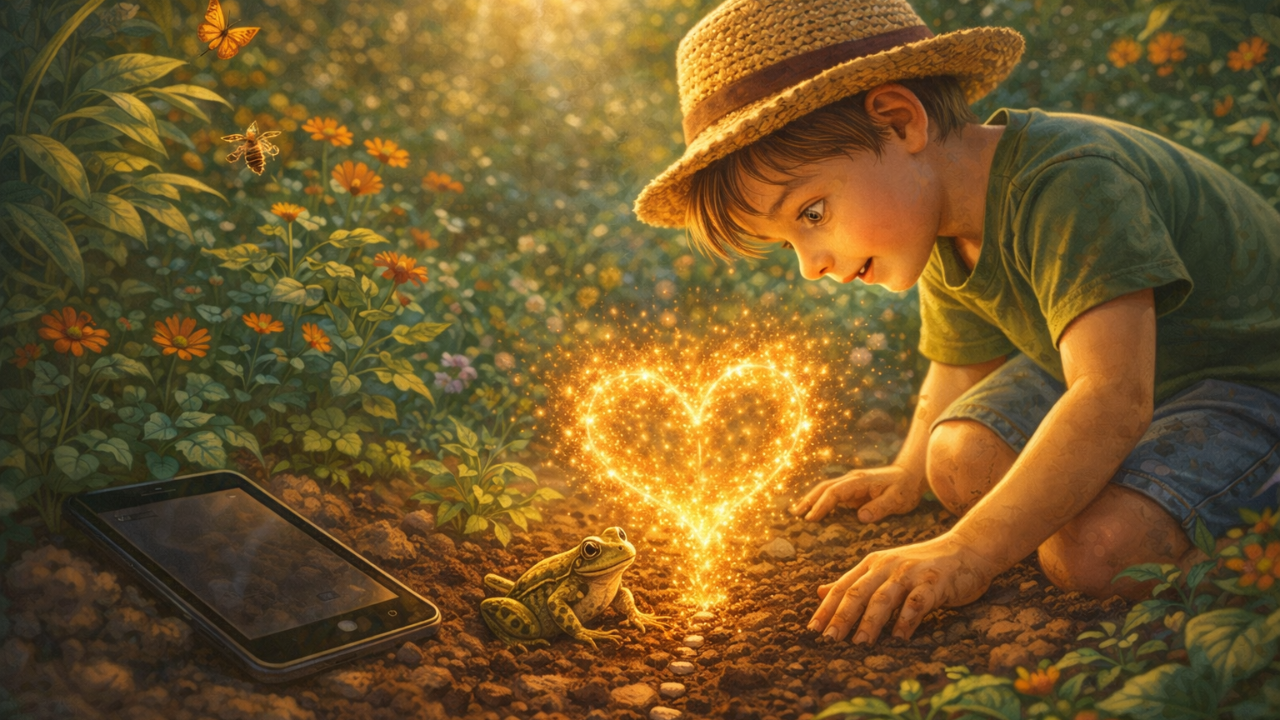
It's time to rewild our learning.
Our world is increasingly dominated by screens, algorithms, and digital learning platforms, and many parents and educators are beginning to ask deeper questions about the future of education.
Are children truly learning—or are they simply adapting to systems designed for efficiency and control?
It's essential to recognize that the educational systems we were raised in are part of the broader agenda of those who have controlled humanity up until now, dulling us down generation by generation into apathy, quiet submission and the inability to think critically, penetratively, or holistically.
And with the proliferation of AI everywhere, brain oblivion is a very real possibility, unless we learn to appreciate and lift up the true value of humanity, and how to cultivate our innate gifts.
In this episode of The Grace Space, I had the pleasure of speaking with multi-award-winning educator Teresa Carolyn, whose decades of experience within the traditional school system, along with her own personal awakening, eventually led her to a sobering realization: the structures we call “education” are not actually be designed to cultivate sovereign, creative human beings.
Teresa’s journey is one that many educators quietly share. Over time, she began to see how institutional learning environments often separate children from their natural curiosity, intuition, and connection with the living world.
Instead of nurturing exploration and creativity, the educational system frequently prioritizes conformity, standardization, and measurable outcomes. The result is a suppression our natural, innate gifts, and more and more, a sense of meaninglessness in the younger generations as they question what it is exactly they are being prepared for in a world of crumbling structures and evident corruption.
As we awaken en masse, we are starting to remember that true learning was never meant to look like what most of us experienced.
In my conversation with Teresa, we explore a different possibility — one where education returns to its natural roots.
In this model, children learn through experience, through nature, through responsibility, and through the innate curiosity that already lives within them.
We discuss the idea that real education is not something delivered to us by institutions, but something drawn out from within.
In fact, the very word education comes from the Latin educere — meaning “to draw out.” This happens to be one of my standout memories from school. A teacher actually expressed this in class, and it has always stayed with me. Not because that was my experience, but, ironically, by its stark contrast to the reality of school. In that moment, something in the child I was immediately recognized that learning was meant to be about awakening innate intelligence, rather than memorization and parroting back what I was told. At the same time, I felt far away from whatever was creative and original in me. Ironically, this moment happened in school, as if truth momentarily shone through this teacher, planting a seed in my awareness that would grow into my long path of autodidactism.
Teresa and I also spoke about the importance of ecological literacy — the understanding that humans are not separate from nature but part of a living system.
When children grow food, build shelters, observe ecosystems, and spend time outdoors, they develop not only practical skills but also a deeper sense of belonging and responsibility. These experiences cultivate resilience, creativity, and sovereignty in ways that no digital platform ever could.
None of this means rejecting technology entirely. But it does invite us to ask whether our current balance is healthy — and whether something essential has been lost in the process.
As Teresa beautifully expresses in our conversation, emotions themselves can serve as a kind of compass, guiding us back toward what is alive and meaningful. Perhaps the future of education will not be about adding more tools, more platforms, or more complexity. Perhaps it will be about remembering something much simpler.
Because at the end of the day…your kid doesn’t need another app.
They need a garden.
Stay connected with news and updates!
I treat your information as sacred.
I will never sell your information, for any reason. That would be totally gross.