
The Counterfeit Reality We Fed
Jun 05, 2026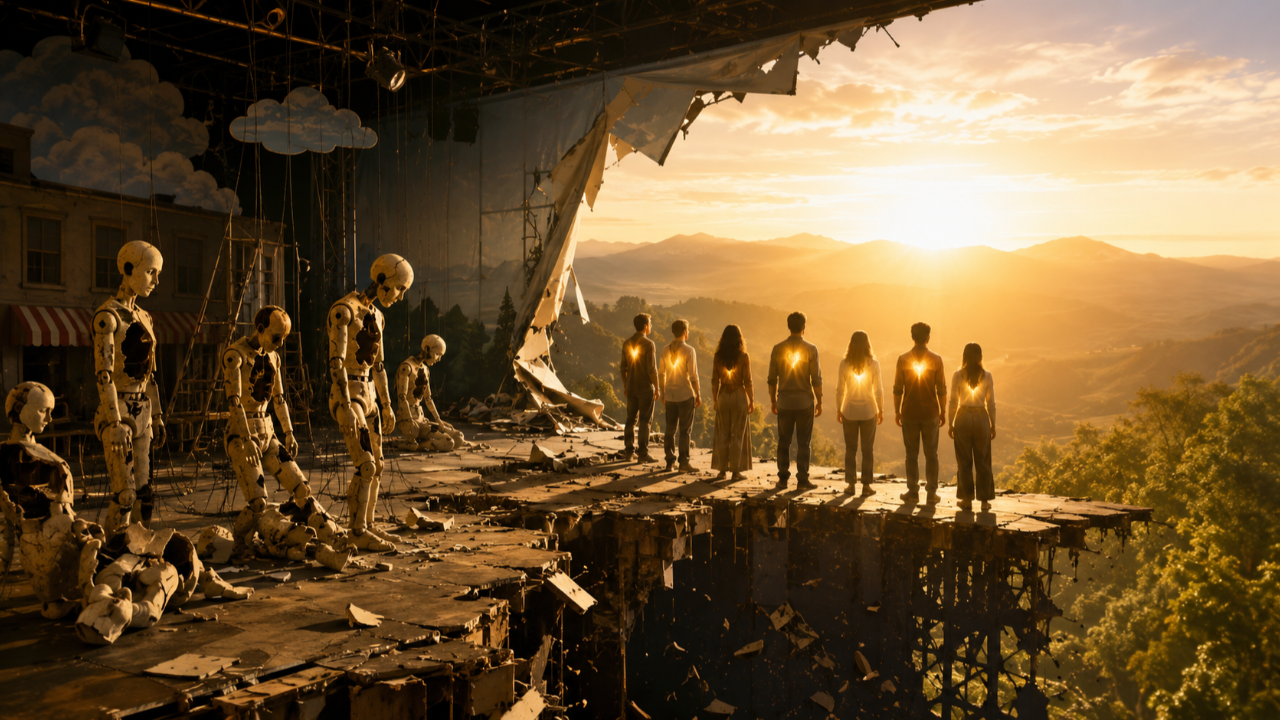
How attention, fear, and quiet awakening may be reshaping the world we thought was fixed
What if the systems that shape our lives are sustained not only by laws, platforms, and institutions, but by something even more intimate—our attention?
Until recently, many of us assumed that there existed some objective reality we could all agree on. But we are starting to see that reality splinter as we realize that whatever we focus on the most seems to actualize, and that what we give our attention to grows. There are people right now who read the signs and think that everything is a disaster, that the world is about to end, that we are doomed. And there are people right now who read the signs and see a golden age of prosperity and love dawning.
What is going on here?
In the matrix reality, power and control have been maintained from the top down, acting and expressing themselves within every system in every domain of human life they sought to shape. But the truth is, that reality has also been reinforced from the inside out, through the countless moments when we give our focus, emotion, and energy to what keeps us fragmented and enslaved. We have built (and paid for) the walls of our own prison, to the great amusement, I’m sure, of the controllers.
To be fair, this has been a very sophisticated stage set. And I must admit that as an actor, I am more fascinated than horrified by the discovery that the entire world has been a stage for my whole life and all the men and women merely players. And that, hilariously, I was fooled by it.
The manufactured reality is just that – full of thrills and chills to keep us pumping out the energy needed to power the AI-generated overlay that maintained our little world. Fear has kept us vigilant. Outrage has kept us engaged. Distraction has kept us shallow. Identification has kept us defending roles, labels, and temporary allegiances as though they were our deepest selves. Over time, unconscious participation has provided the fuel source, and the machine keeps running because we keep feeding it with urgency, attention, and repetition.
A theme is emerging here – once again, we have not realized the power we have.
WE are the batteries that power this matrix. We always have been. Which means we are also the off-switch. Without our belief, without our attention, without our energy, it falls apart. Instantly.
Something is shifting.
More people seem to be noticing the pattern itself, not just the individual events inside it. They are beginning to recognize how easily attention is manipulated, how quickly public emotion can be steered, and how often noise is mistaken for truth. This growing awareness does not always arrive as a dramatic revelation. Sometimes it begins as a small discomfort—the sense that something is off, that the script feels too familiar, too hollow, that the emotional cues are arriving a little too predictably.
Not to mention the plastic faces of the robotic news readers. And the occasional – actual – MASK that seems to be coming away from the edge of someone’s face on national television.
Crazy times, people. Crazy times.
But this isn’t new. It’s just that we’re now seeing the edges of the movie set for the first time.
Or, to borrow a familiar cultural metaphor, it can feel like noticing the walls of The Truman Show. Long one of my favorite movies (and partly because it was filmed less than an hour away from me in Seaside, Florida, which literally does look like that), it reveals that startling moment when the ordinary world no longer feels entirely natural, and the person inside it begins to suspect that what looked like everyday life was actually curated to the teeth. As critics often note, The Truman Show resonates because it captures the tension between appearance and reality, comfort and freedom, performance and truth.
And maybe because it tells us some profound truth about our own situation, as many movies do, whether they function as soft disclosure or predictive programming.
In any case, once an illusion is recognized as an illusion, it loses some of its power. It may still exist. It may still dominate headlines, shape conversations, and pressure behavior. But it can no longer operate with the same invisibility. Awareness changes the relationship. What was once absorbed automatically is now observed. What once triggered reflex or reactivity can now be met with discernment.
That is why the old system was never sustained by force alone. Force matters, of course. Incentives matter. Structures matter. But durable systems also depend on internalized agreement—on the stories people repeat, the fears they inherit, and the habits they never think to question. A structure becomes truly powerful when it no longer needs to shout because it has already been installed in the mind.
It was sustained by attention—by the steady stream of focus and belief we offered it. It was sustained by fear—because frightened people are easier to program. It was sustained by consent—often not explicit consent, but the quiet compliance that grows when people feel powerless, exhausted, or disconnected from themselves. And perhaps most of all, it was sustained by forgetting: forgetting who we truly are. The deep amnesia, the hypnotic trance that is beginning to loosen its clutches and fall away.
That is why this moment matters. Across communities, conversations, and private inner lives, people are beginning to remember. Not necessarily in blinding flashes of light, and not all in the same language. Some are remembering their capacity to think clearly beneath pressure. Some are remembering that not every invitation to react deserves a response. Some are remembering that a human being is more than a profile, a faction, or a programmable pattern of outrage.
This kind of remembering rarely looks spectacular. It is often quiet, personal, and almost invisible from the outside.
It happens in conversations where people choose honesty over performance. It happens when someone refuses to be manipulated by panic. It happens when attention is reclaimed and given to what is true, humane, and life-giving.
Recently, in a conversation with healer and author Katie Bishop, we found ourselves circling around a simple but profound idea: perhaps the opposite of manipulation is not information but authenticity.
The system thrives on masks. It thrives on personas, tribal identities, programmed reactions, and inherited beliefs that have never been examined. It thrives when we perform versions of ourselves that keep us disconnected from what we actually feel and know.
Authenticity is different.
Authenticity is what remains when the performance ends. It is what emerges when the fear is felt rather than avoided, when the conditioning is questioned rather than obeyed, and when the noise becomes so overwhelming that we are finally forced to listen for something deeper.
Perhaps that is why the human heart has become so important in this moment. Not the sentimental heart. Not the romantic heart. The heart as an organ of discernment. The heart as a compass. The heart as the one place within us that cannot be programmed, purchased, or hacked.
For years we have been feeding a reality built from distraction, fear, outrage, and unconscious consent. But the moment we begin paying attention to what is true instead of what is merely loud, the machinery begins to starve.
The moment we reclaim our attention, we reclaim our power.
And perhaps that is what we are witnessing now. Not the end of the world -- not even the collapse of civilization. But the gradual dismantling of a counterfeit reality that could only survive as long as we continued to believe in it.
One person at a time.
One act of courage at a time.
One reclaimed piece of attention at a time.
One awakened heart at a time.
Stay connected with news and updates!
I treat your information as sacred.
I will never sell your information, for any reason. That would be totally gross.